last update; Aug. 24. 2018
| Type | Target gene | Requirements for Additional genes | Maximum number of genes to select | Indication of conserved nodes in the orthologus gene(s) |
Edges | Genes without any edge | Example |
|---|---|---|---|---|---|---|---|
| For a perticular gene | one target gene (yellow node) |
upto 4-path coexpression | 20 | yes (orange nodes) | Top 3 MR | not draw | 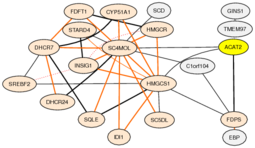 |
| GO network | genes in a GO term (lighter gray or orenge nodes) |
1-path coexpression for at least 2 target genes | 200 | yes (orange nodes) | Top 3 MR | not draw | 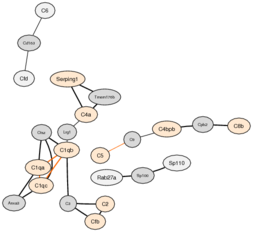 |
| Tissue-specific network | genes expressed in a tissue (white nodes) |
no addition | 1000 | no | Top 2 MR | not draw | 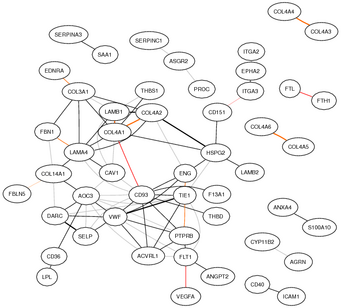 |
| User-defined gene network | all user-defined genes (lighter gray) |
upto 2-path coexpression | 100 | no | Top 3 MR | draw (default) |
Correlation rank is asymmetric, namely the rank of gene B from gene A is not the same as the rank of gene A from gene B.
And thus, the geometric averaged rank between the two directional ranks is used, which we call Mutual Rank (MR).
| MR(AB) = √ (Rank(A→B) x Rank(B→A)) |
After the extraction of genes, all relationships in the drawing gene list are drawn according to the following thresholds;
| AveRank | Line thickness |
|---|---|
| 1 ~ 5 | Bold lines |
| 5 ~ 30 | Normal lines |
| 30 ~ | Weak lines |